
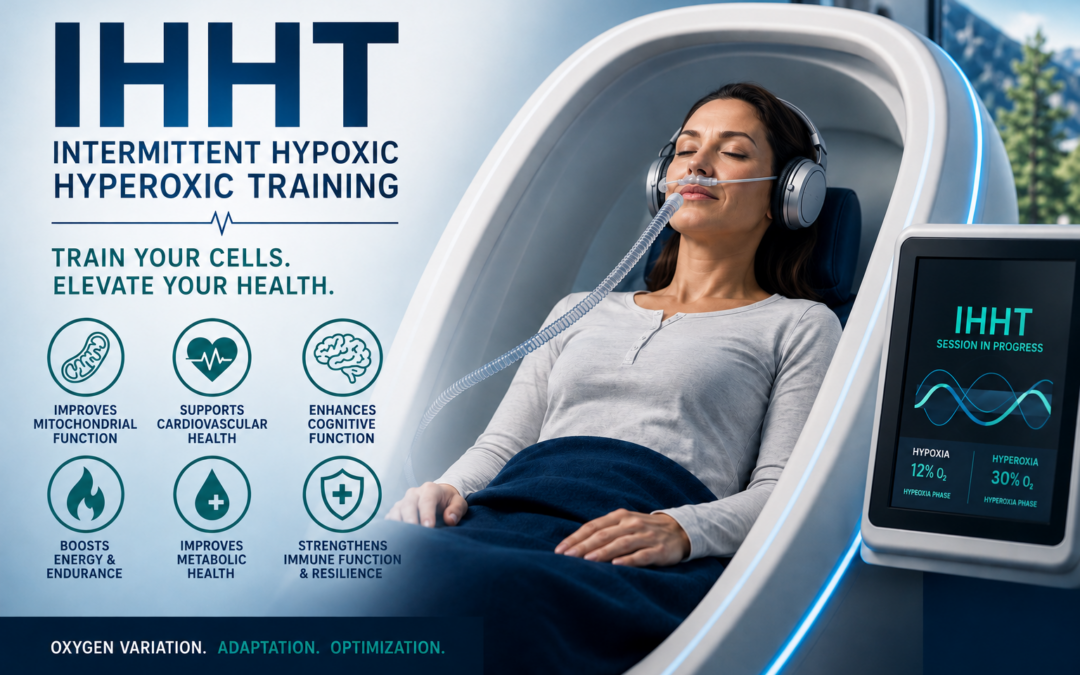
The search for effective, non-invasive interventions that improve healthspan—not just lifespan—has accelerated rapidly. Among the most promising emerging therapies is Intermittent Hypoxic-Hyperoxic Training (IHHT). Originally developed for elite athletes and high-altitude conditioning, IHHT is now being applied in clinical and longevity-focused settings to improve mitochondrial function, cardiovascular health, metabolic efficiency, and resilience to stress.
This is not a fringe modality. The underlying mechanisms are grounded in well-established physiological responses to oxygen variation—responses that humans have evolved to handle but rarely experience in modern life.
This article breaks down what IHHT is, how it works, and why it is increasingly being positioned as a cornerstone therapy for adults over 50 who want measurable improvements in energy, recovery, and long-term health.
What Is IHHT?
Intermittent Hypoxic-Hyperoxic Training (IHHT) involves controlled breathing cycles where an individual inhales air with lower oxygen levels (hypoxia) followed by periods of higher-than-normal oxygen levels (hyperoxia).
Unlike traditional altitude training, IHHT is:
- Passive (no physical exertion required)
- Precisely controlled
- Individually calibrated
- Delivered via a medical-grade device
A typical session lasts 30–45 minutes and consists of alternating cycles:
- Hypoxia phase: Oxygen levels reduced to simulate altitude (often 10–14% O₂)
- Hyperoxia phase: Oxygen levels increased above normal (up to ~30–35% O₂)
This alternating exposure creates a powerful stimulus at the cellular level—particularly within the mitochondria.
The Core Mechanism: Mitochondrial Optimization
At the center of IHHT’s benefits is mitochondrial function.
Mitochondria are responsible for:
- ATP (energy) production
- Cellular signaling
- Apoptosis (cell cleanup)
- Oxidative stress regulation
As people age, mitochondrial efficiency declines. Damaged mitochondria accumulate, leading to:
- Reduced energy output
- Increased inflammation
- Higher oxidative stress
- Greater susceptibility to chronic disease
IHHT addresses this directly through a process similar to mitochondrial quality control.
Selective Mitophagy
During hypoxic phases, weaker or damaged mitochondria struggle to function and are selectively eliminated. During hyperoxic phases, healthy mitochondria are supported and strengthened.
The net effect:
- Removal of dysfunctional mitochondria
- Improved efficiency of remaining mitochondria
- Increased overall cellular energy production
This is one of the most compelling mechanisms linking IHHT to longevity.
Activation of Hypoxia-Inducible Factors (HIFs)
A key biological pathway activated during IHHT is the Hypoxia-Inducible Factor (HIF) system.
HIFs regulate genes involved in:
- Oxygen delivery
- Red blood cell production
- Angiogenesis (new blood vessel formation)
- Glucose metabolism
When exposed to intermittent hypoxia:
- The body upregulates HIF-1α
- This triggers adaptive responses that improve oxygen utilization
- Tissues become more efficient at extracting and using oxygen
This is particularly relevant for aging populations, where oxygen delivery and utilization tend to decline.
Cardiovascular Benefits
IHHT has been shown in multiple studies to improve cardiovascular markers without requiring physical strain.
Key Effects:
- Improved endothelial function
- Increased nitric oxide availability
- Reduced blood pressure
- Enhanced microcirculation
For adults over 50, these outcomes are critical. Cardiovascular disease remains the leading cause of mortality, and many individuals cannot tolerate high-intensity exercise.
IHHT provides a low-impact alternative that still delivers meaningful vascular adaptations.
Metabolic Health and Insulin Sensitivity
Metabolic dysfunction—particularly insulin resistance—is a central driver of aging and chronic disease.
IHHT influences metabolic health through:
- Improved glucose uptake
- Enhanced mitochondrial fat oxidation
- Reduction in systemic inflammation
Some studies have demonstrated improvements in:
- Fasting glucose
- HbA1c levels
- Lipid profiles
Mechanistically, this is tied to both mitochondrial efficiency and HIF-driven metabolic adaptations.
Cognitive Function and Brain Health
The brain is highly sensitive to oxygen availability and mitochondrial performance.
IHHT may support cognitive health through:
- Increased cerebral blood flow
- Enhanced neuroplasticity
- Reduction in oxidative stress
- Upregulation of brain-derived neurotrophic factor (BDNF)
Emerging research suggests potential applications in:
- Mild cognitive impairment
- Age-related cognitive decline
- Neurodegenerative conditions
While more large-scale trials are needed, the early data is directionally strong.
Stress Resilience and Nervous System Regulation
IHHT acts as a controlled hormetic stressor.
Hormesis refers to the concept that small, controlled stress exposures can strengthen biological systems.
With IHHT:
- Hypoxia acts as the stressor
- Hyperoxia supports recovery
This alternating pattern trains the body to:
- Adapt more efficiently to stress
- Improve autonomic nervous system balance
- Enhance recovery capacity
Many users report improvements in:
- Sleep quality
- Energy stability
- Perceived stress levels
—————————————————————————————————
Watch our Featured Longevity Leaders Interview with
Michael Prewitt, CEO, Respira Global
Watch the video interview about IHT HERE
—————————————————————————————————
Athletic Recovery and Performance
Although IHHT is now widely used in longevity clinics, its origins are in sports performance.
Benefits for active individuals include:
- Faster recovery between workouts
- Improved oxygen utilization (VO₂ efficiency)
- Increased endurance capacity
- Reduced fatigue
Unlike traditional altitude training, IHHT does not require relocation or intense physical strain, making it more accessible.
Immune Function and Inflammation
Chronic inflammation is a key driver of aging and disease.
IHHT may contribute to:
- Reduction in pro-inflammatory cytokines
- Improved immune cell efficiency
- Enhanced resilience to oxidative stress
These effects are mediated through both mitochondrial optimization and HIF-related pathways.
Who Is IHHT Best For?
IHHT is particularly relevant for:
Adults Over 50
- Declining mitochondrial function
- Reduced cardiovascular efficiency
- Increased metabolic risk
High-Performing Individuals
- Seeking recovery optimization
- Managing stress load
- Improving energy output
Individuals With Limited Mobility
- Unable to perform high-intensity exercise
- Looking for passive but effective interventions
Longevity-Focused Individuals
- Interested in proactive, data-driven health strategies
- Seeking measurable improvements in biological function
Safety and Personalization
IHHT is generally well-tolerated when administered correctly. However, it is not a one-size-fits-all protocol.
Proper implementation requires:
- Baseline oxygen saturation assessment
- Individualized hypoxia tolerance calibration
- Continuous monitoring during sessions
Contraindications may include:
- Severe cardiovascular instability
- Certain pulmonary conditions
- Acute illness
This is why clinical-grade systems and professional oversight are critical.
IHHT vs. Traditional Oxygen Therapies
It’s important to distinguish IHHT from other oxygen-based therapies:
|
Therapy Type |
Mechanism |
Primary Use |
|
Hyperbaric Oxygen Therapy (HBOT) |
High-pressure oxygen |
Wound healing, neurological recovery |
|
Supplemental Oxygen |
Increased oxygen only |
Respiratory support |
|
IHHT |
Alternating low/high oxygen |
Cellular adaptation, longevity |
IHHT is unique because it leverages dynamic oxygen variation, not static exposure.
The Longevity Angle: Why IHHT Matters
If you step back and evaluate IHHT through a longevity lens, it checks several critical boxes:
- Targets root cause (mitochondrial dysfunction)
- Improves multiple systems simultaneously
- Non-invasive and scalable
- Compatible with other protocols (nutrition, exercise, sleep)
Most longevity strategies focus on inputs (diet, supplements, exercise). IHHT works at the level of cellular processing—how efficiently your body converts those inputs into usable energy.
That distinction matters.
Integration Into a Longevity Protocol
IHHT is not a standalone solution. It works best when integrated into a broader system.
A practical framework:
- Foundation
- Sleep optimization
- Nutrition (protein, micronutrients)
- Movement
- Enhancement
- Strength training
- Cardiovascular conditioning
- Stress management
- Advanced Therapies
- IHHT
- Red light therapy
- Cold exposure
Within this structure, IHHT functions as a force multiplier.
Practical Considerations
Before starting IHHT, consider:
- Access to a certified provider or system
- Frequency (typically 2–3 sessions per week initially)
- Measurable goals (energy, recovery, metabolic markers)
Consistency is more important than intensity.
Final Assessment
IHHT is not hype. It is a clinically grounded intervention that targets one of the most fundamental aspects of aging: cellular energy production.
For individuals over 50, this is a high-leverage opportunity.
The combination of:
- Mitochondrial optimization
- Cardiovascular improvement
- Metabolic enhancement
- Stress resilience
positions IHHT as one of the more comprehensive non-pharmaceutical tools currently available.
The limiting factor is not effectiveness—it is access and proper implementation.
Watch our Featured Interview with
Michael Prewitt, CEO, Respira Global
Watch the video interview about IHT HERE