
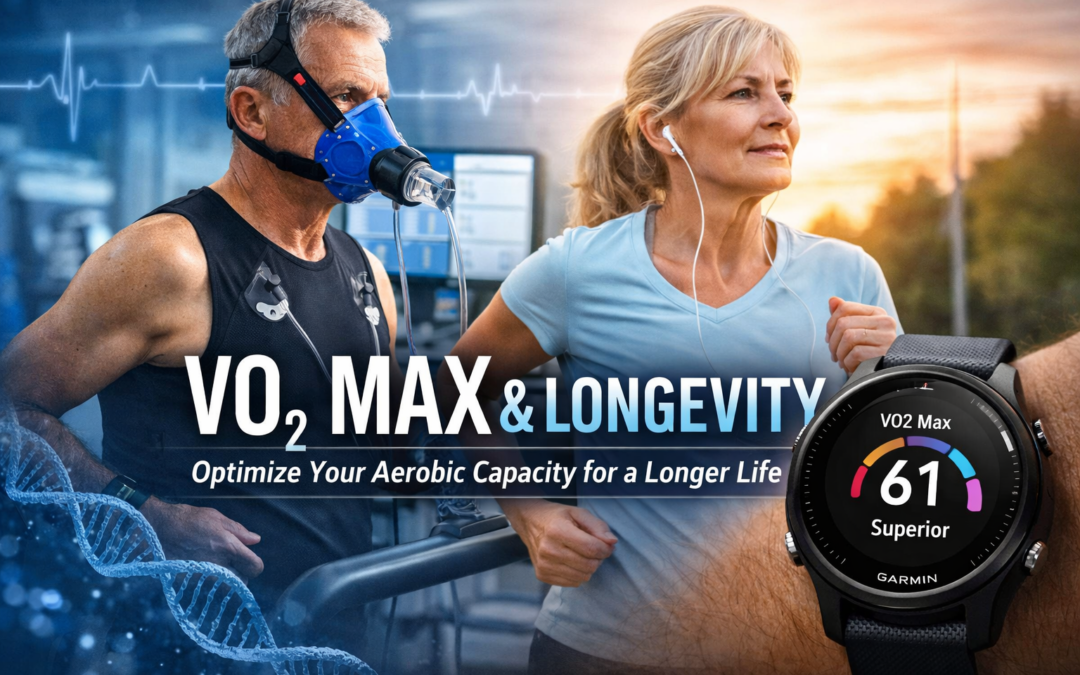
VO₂ max is not a trendy fitness metric.
It is not a gadget gimmick.
And it is absolutely not “just for runners.”
VO₂ max is one of the most powerful, well-validated indicators of cardiovascular health, functional capacity, and long-term survival we have in human physiology—especially for adults over 50.
In fact, organizations like the American Heart Association have repeatedly highlighted cardiorespiratory fitness (CRF), of which VO₂ max is the gold-standard measure, as one of the strongest predictors of cardiovascular disease and all-cause mortality—often stronger than cholesterol, blood pressure, or BMI.
What VO₂ Max Actually Is
VO₂ max stands for:
- V = Volume
- O₂ = Oxygen
- Max = Maximum
Put simply:
VO₂ max is the maximum amount of oxygen your body can absorb, transport, and use to produce energy during intense exercise.
It reflects the combined performance of:
- Your lungs (oxygen intake)
- Your heart (cardiac output)
- Your blood (oxygen transport)
- Your muscles and mitochondria (oxygen utilization)
This is why VO₂ max is often referred to as maximal aerobic capacity—it represents the ceiling of your aerobic engine.
And here’s the blunt truth:
If your aerobic engine is weak, everything else ages faster.
How VO₂ Max Is Measured (Lab vs. Real-World Estimates)
1. The Gold Standard: Laboratory Testing
The only truly direct measurement of VO₂ max occurs in a controlled exercise physiology lab using cardiopulmonary exercise testing (CPET).
This involves:
- Wearing a tight-fitting metabolic mask
- Exercising on a treadmill or bike with steadily increasing intensity
- Continuous measurement of:
- Oxygen inhaled (VO₂)
- Carbon dioxide exhaled (VCO₂)
- Monitoring heart rate, workload, and respiratory exchange
When oxygen consumption plateaus despite increasing workload, VO₂ max has been reached.
This method is precise—but expensive, time-consuming, and unnecessary for most non-athletes.
2. Field & Wearable Estimates (Good Enough for Longevity)
Most people today encounter VO₂ max via wearables like Garmin or Whoop, which use algorithms developed by Firstbeat.
These estimates are derived from:
- Heart rate response
- Running or walking speed
- Power output (cycling)
- Age, sex, height, weight
- Repeated training data over time
Firstbeat reports ~95% correlation with lab testing under ideal conditions, but here’s the real takeaway:
Wearable VO₂ max is not an exact number—it’s a trend indicator.
And for longevity purposes, the trend matters far more than the absolute value.
3. Simpler Estimation Methods (Functional, Not Fancy)
Classic tests like the Cooper 12-minute run test, developed by the Cooper Institute, estimate VO₂ max based on distance covered.
These methods are:
- Crude
- Inaccurate at the individual level
- Still useful for population-level fitness assessment
Again: good enough to guide behavior, not diagnose physiology.
What VO₂ Max Is Measured In (And Why It Matters)
VO₂ max is expressed as:
ml/kg/min
- milliliters of oxygen
- per kilogram of body weight
- per minute
This normalization is critical because it reflects functional capacity relative to body mass, not just raw oxygen consumption.
Two people can have identical hearts—but the one who uses oxygen more efficiently lives longer and functions better.
Why VO₂ Max Predicts Longevity So Powerfully
Here’s the part most fitness articles get wrong.
VO₂ max isn’t important because it makes you faster.
It’s important because it reflects how resilient your physiology is under stress.
Higher VO₂ max is associated with:
- Lower all-cause mortality
- Lower cardiovascular mortality
- Reduced risk of metabolic disease
- Better cognitive aging
- Greater independence with age
- Lower frailty risk
- Higher stress tolerance
Multiple long-term cohort studies show that each incremental increase in cardiorespiratory fitness reduces mortality risk, even in older adults—and even when improvements occur later in life.
Translation:
It is never “too late” to improve VO₂ max—and doing so still meaningfully extends healthspan.
Why VO₂ Max Matters Even More After 50
After age 30, VO₂ max declines naturally—about 5–10% per decade if untrained. After 50, the decline accelerates if nothing is done.
Low VO₂ max in older adults correlates strongly with:
- Loss of independence
- Increased fall risk
- Poor surgical outcomes
- Cognitive decline
- Higher hospitalization rates
Here’s the uncomfortable truth:
Many people don’t “die of old age”—they die because their aerobic reserve drops below the threshold needed to survive stress.
Infections, surgeries, falls, heat exposure—these all demand aerobic capacity. VO₂ max is your physiological savings account.
What Is a “Good” VO₂ Max for 50+ Adults?
Absolute numbers matter less than percentile ranking for age and sex.
That said:
- Being in the “good” or higher category dramatically lowers risk
- Moving from “poor” to “fair” yields enormous health benefits
- Small improvements (5–10%) deliver outsized longevity returns
Elite numbers are irrelevant for longevity. Functional reserve is the goal, not bragging rights.
Men vs. Women: Why the Difference Exists
Men generally show higher VO₂ max due to:
- Higher red blood cell mass
- Larger hearts and lungs
- Higher lean muscle mass
- Lower essential body fat percentage
This is physiological—not a value judgment. What matters is relative fitness for your sex and age, not comparison across groups.
Can You Improve VO₂ Max After 50? Absolutely—But Be Smart
VO₂ max improves through aerobic stress + recovery adaptation.
Mechanisms include:
- Increased mitochondrial density
- Improved capillary networks
- Enhanced stroke volume of the heart
- Improved oxygen extraction at muscle level
The most effective strategies:
- Interval training (appropriately dosed)
- Brisk walking with hills
- Cycling, rowing, swimming
- Zone-2 aerobic base + occasional intensity
Here’s the hard truth:
Consistency beats intensity. Injury kills progress faster than age ever will.
Final Takeaway: Why VO₂ Max Belongs in Every Longevity Framework
VO₂ max is not about running faster.
It’s about living longer, thinking more clearly, and staying independent.
For adults over 50, it is:
- A vital sign
- A risk stratification tool
- A modifiable predictor of survival
You don’t need a lab test.
You don’t need elite numbers.
You need progress, consistency, and respect for recovery.
If you’re serious about longevity, VO₂ max is not optional—it’s foundational.
BONUS: Review of the numbers:
Here are clear, realistic reference VO₂ max numbers for people over 50, grounded in population data used by exercise physiologists, wearables, and clinical fitness research. This is what actually matters for longevity.
VO₂ Max Reference Ranges for Adults 50+
These values are expressed in ml/kg/min and reflect cardiorespiratory fitness, not athletic performance.
Men
|
Age |
Poor |
Fair |
Good |
Excellent |
Superior |
|
50–59 |
< 35 |
35–39 |
39–44 |
45–48 |
≥ 49 |
|
60–69 |
< 32 |
32–35 |
35–40 |
41–45 |
≥ 46 |
|
70–79 |
< 29 |
29–32 |
32–36 |
37–41 |
≥ 42 |
Women
|
Age |
Poor |
Fair |
Good |
Excellent |
Superior |
|
50–59 |
< 30 |
30–33 |
33–37 |
38–41 |
≥ 42 |
|
60–69 |
< 27 |
27–30 |
30–33 |
34–37 |
≥ 38 |
|
70–79 |
< 25 |
25–28 |
28–31 |
32–35 |
≥ 36 |
The Longevity Lens (This Is the Part Most Charts Miss)
Here’s the most important takeaway:
1. The biggest longevity gains happen at the bottom
Moving from Poor → Fair produces a larger mortality risk reduction than moving from Excellent → Superior.
This has been shown repeatedly in long-term cohort studies using cardiorespiratory fitness as a predictor.
Low VO₂ max is dangerous. Moderate VO₂ max is protective. High VO₂ max is a bonus.
2. Below these thresholds = higher risk
From a longevity and independence standpoint, red flags start around:
- Men 50+: < 35 ml/kg/min
- Women 50+: < 30 ml/kg/min
Below this range, we see:
- Higher all-cause mortality
- Greater cardiovascular risk
- Faster loss of functional independence
- Poorer surgical and illness recovery
3. You do NOT need “elite” numbers
For healthspan and lifespan:
- Men 50+: 40–45 is a very strong target
- Women 50+: 33–38 is a very strong target
These levels are associated with:
- Dramatically lower cardiovascular mortality
- Better cognitive outcomes
- Lower frailty risk
- Higher stress resilience
Perspective That Matters for 50+ Adults
VO₂ max declines ~1% per year after midlife if untrained.
That means:
- Holding steady = success
- Improving = exceptional
- Declining rapidly = warning signal
In longevity terms, VO₂ max is not a fitness stat—it’s a physiological survival reserve.
One Last Talk Point
If you’re over 50 and:
- You can walk briskly uphill without stopping
- Recover your breathing quickly
- Handle short bursts of intensity without crashing
You’re likely well above the danger zone, even if your wearable number isn’t perfect.
Trend is better than perfection.
About the Longevity Academy
The Longevity Academy exists to help people 50+ extend their healthspan—not just their lifespan—using science-backed strategies that actually move the needle. We cut through hype and trends to deliver practical education on nutrition, movement, brain health, metabolic fitness, recovery, and emerging longevity therapies. Our mission is simple: help you stay strong, sharp, and independent for decades longer than the standard aging playbook allows.
Are you ready?
If you’re serious about aging on your own terms, don’t stop here. Join the Longevity Academy to access expert-led courses, weekly longevity insights, and proven protocols you can put into action immediately. Subscribe, enroll, or explore our programs today and start building your longevity advantage. LEARN MORE